
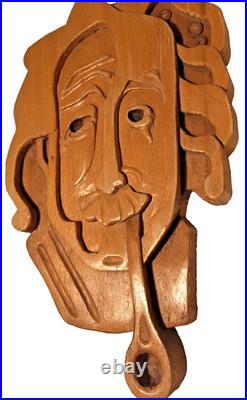
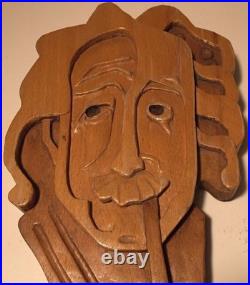
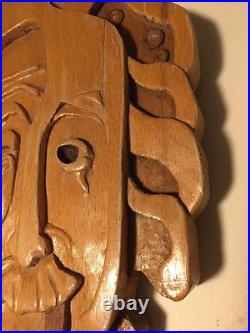
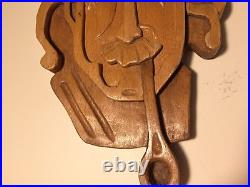
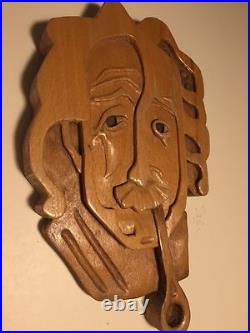
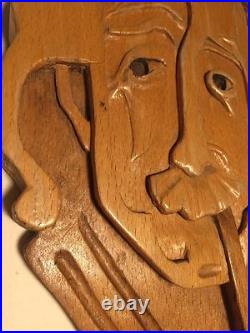
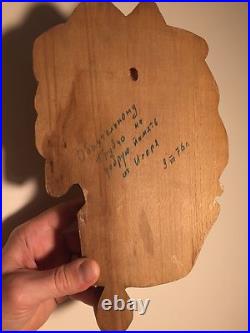

A wildly charismatic slice of 1970s folk-art creativity-this hand-carved wooden wall plaque captures the unmistakable persona of Albert Einstein, the most mythic mind of the 20th century, reimagined through psychedelic-era lines, sculptural flair, and the warm grain of hardwood oak. Carved and dated June 9th, 1976, and inscribed in Russian on the back, this piece functions as both a portrait and a tribute: To the sociable Grubo, as a good memory, from Igor. A heartfelt dedication from one friend to another, preserved in flowing Cyrillic and transliterated into Latin script. 11 inches tall (to the tip of Einstein’s signature pipe). Approximately 1 inch thick at the deepest point. Carved from a single slab of hardwood (appears to be oak). Features psychedelic, flowing carved contours typical of the mid-70s folk art aesthetic. This is a self-identifying portrait of Einstein-instantly recognizable by his tousled hair, mustache, and that thoughtful pipe-yet stylized in a way only the 1970s could pull off: organic lines, earthy materials, and a sense of brainy tranquility drifting out like pipe smoke. A Brief Einstein Spotlight. Albert Einstein wasn’t just a scientist; he was a universe-bender. The man took time and space-the two things we all naïvely assumed were solid-and showed they stretch, warp, and bend. He didn’t work in some glamorous laboratory; he cooked up his “Miracle Year” papers in 1905 while holding a desk job at a Swiss patent office. That’s the energy this plaque channels: the brilliant, slightly mischievous thinker who looked at reality and said. I bet I can make this weirder. His theories gave us the modern understanding of spacetime, black holes, GPS, particle physics, and the structure of the universe. Ironically enough, his famous equation E = mc² is also the foundation of nuclear energy-energy stored at the atomic level, waiting to be released. Which ties in beautifully with the carved dedication on this piece. And with these mind-stretching facts. Indigenous groups in Northern Australia have ancient stories about a great creation spirit-dragon-like-sleeping beneath the ground. The place they describe happens to sit on Earth’s. Most naturally abundant uranium deposit. Disturb the sleeping spirit, they warn, and catastrophe follows. Modern geology quietly agrees: that “sleeping spirit” is uranium, packed with trapped energy from the birth and death of stars. A Major League baseball weighs about 5.25 ounces. A baseball made of uranium? Over 8.5 pounds. Einstein’s world literally bent under the weight of the elements he helped us understand. Many physicists believe uranium is the frozen residue of a supernova -the remnant of a star’s explosive death, with immense cosmic energy locked at the atom level. Einstein was the one who showed us how mass and energy are really the same thing wearing different hats. This folk-art portrait-born in 1976, in the middle of the Cold War, the space race, and the global nuclear age-captures the era’s fascination with Einstein as the ultimate symbol of intelligence, curiosity, and star-forged mystery. Vintage 1976 example in excellent display condition with honest age to the wood and inscription. No cracks or structural issues. Ready to hang, admire, and spark conversation. Because it isn’t just a carved portrait. It’s 1970s cosmic folk-art meeting the mind that redefined the universe. It’s Einstein with a pipe-calm as can be-while spacetime does gymnastics behind him. It’s a personal gift from 1976, carved in oak, carrying a story, an inscription, and a serious dose of retro charm. June 1976 in the USSR – What Was Going On? The Soviet Union was deep in the Brezhnev Era. Is only half the story. For everyday people, this was also the era of. High skill in craftsmanship. Strong hobbyist cultures woodcarving, metalwork, pyrography, etc. Rich artistic gifting traditions. Your plaque fits that ethos perfectly -a handmade gift from Igor to “the sociable Grubo, ” carved in a time when personalized, artisanal objects were prized because mass-produced Western goods weren’t available. 1976 was the Year of the 25th Communist Party Congress. Just a few months before your plaque was carved (February-March 1976), the USSR held its major 25th Party Congress -a huge political and cultural event. Promoting Soviet admiration for figures like Einstein (yes-Einstein was commonly referenced despite Cold War tensions). Encouraging cultural “friendship gifts, ” folk carving, and artistic expression. It’s very plausible your piece was made in this general celebratory atmosphere. A Surge in Folk Art & Amateur Art Circles. By 1976, the USSR had massive networks of Dom Kultury (“Houses of Culture”), which taught woodworking, carving, painting, sculpture, etc. This is exactly the kind of place where. Igor could have carved it. Grubo could have been a member. Friendships like “To the sociable Grubo. From Igor” were formed. The flourishing of folk and amateur craft in the mid-70s is an authentic cultural backdrop. A symbol of intellectual brilliance. All of which appealed to Soviet intellectual and artistic circles. By the 1970s, Einstein’s face was iconic in the USSR, appearing in. Scientific youth club art. Your plaque fits precisely into this tradition. While June 9th wasn’t associated with a major event, consider. It was the start of summer holiday season. Many Soviets exchanged gifts at the end of school terms, graduation periods, or club seasons. Personal dedications commonly included exact dates like this for memory and sentiment. So the date reads exactly like a “friendship gift” made at the close of a season, project, or club activity. 1976 Was a Moment of Growing Détente. Soviet relations in 1976 were still in a period of. Interestingly, Einstein-though long deceased-was often invoked in Soviet publications about peace, scientific internationalism, and the shared destiny of humankind. That means your carved Einstein mask is perfectly aligned with the cultural messaging of that year.