
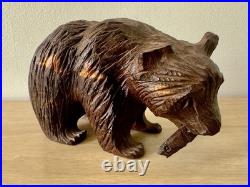
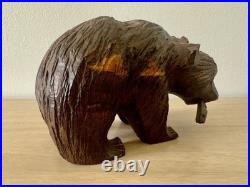
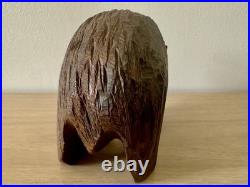
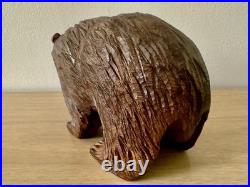
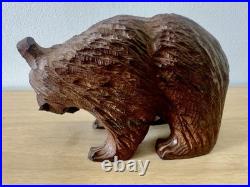
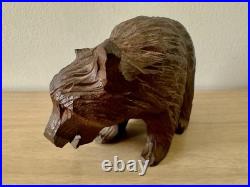
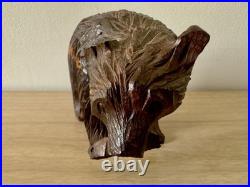
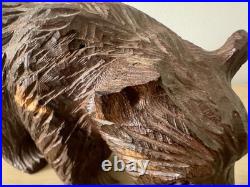
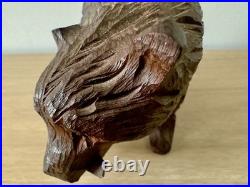
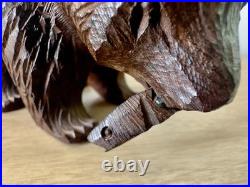
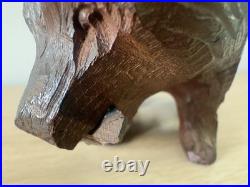
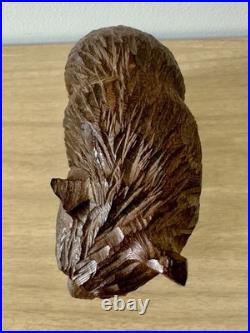
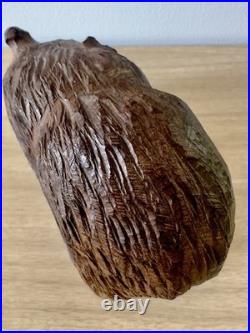
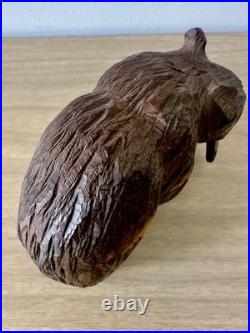
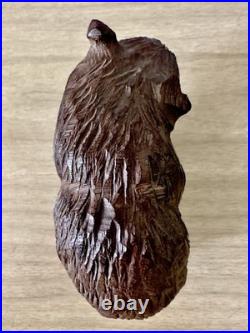
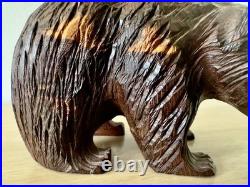
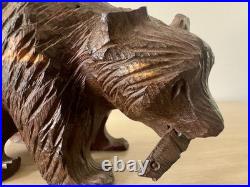
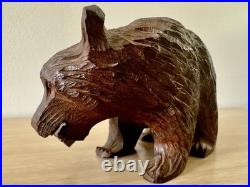
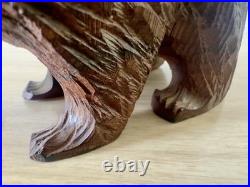
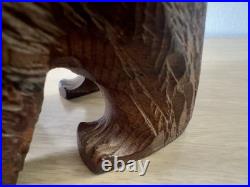
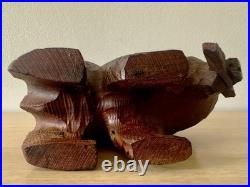
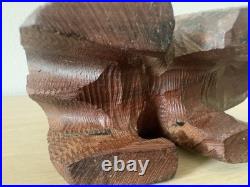
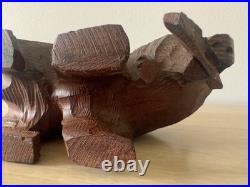
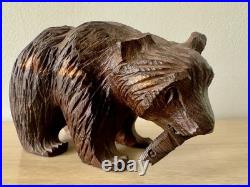

This hand-carved wooden bear sculpture represents a traditional Japanese folk art form associated with Hokkaido and the cultural influence of the Ainu people, the indigenous population of northern Japan. Bears hold deep symbolic importance in Ainu culture, historically regarded as sacred beings and messengers between the human and spirit worlds. Because of this, the bear became one of the most enduring and culturally significant subjects in regional carving traditions. The carving technique seen here-bold, deeply incised gouge marks used to define the bear’s fur and musculature-is characteristic of Ainu-influenced craftsmanship. These techniques became especially prominent and widely collected during the mid-20th century, when interest in indigenous Japanese crafts expanded beyond local use into broader artistic and cultural appreciation. This example reflects that mid-century period clearly. The carving prioritizes sculptural mass, movement, and surface rhythm over decorative smoothness. Tool marks are intentional, confident, and directional, giving the figure a sense of weight and motion. The bear is shown holding a fish in its mouth, a classic and culturally meaningful motif symbolizing sustenance, survival, and strength. The fish on this example is fully intact, an important detail for collectors. Wood and Material Explanation. The sculpture is carved from a dense solid hardwood. It is often common for carvings of this type to be casually labeled online as “ironwood, ” but that designation is incorrect here. True ironwood carvings-most often associated with Mexican or Central American production-tend to display extremely uniform coloration, a slick or glassy surface, and resistance to deep, sharp gouge work. In contrast, this carving shows pronounced grain response, deep tool penetration, and natural tonal variation. The two distinct wood tones visible across the surface are the result of genuine hardwood characteristics, not staining or later alteration. These tonal shifts are commonly seen in authentic Japanese hardwood carvings and are considered a sign of honest material and age. They are not repairs, composite woods, or evidence of mixed materials. The weight and density of the piece further support the use of a solid hardwood rather than resin, softwood, or tourist-grade materials. This is not a factory-made souvenir or modern decorative object. It is a hand-carved sculptural work with clear cultural roots and strong mid-century character. Hand-carved Japanese bear sculpture. Ainu-influenced folk art tradition. Origin: Hokkaido, Japan. Mid-century modern period, circa 1950s-1970s. Solid hardwood construction, dense and weighty. Deep expressive gouge carving used to depict fur. Classic bear-with-fish motif. Natural two-tone coloration from grain, heartwood/sapwood variation, and age. Not ironwood; not Mexican in origin. No maker’s mark visible, typical for this genre. Length: 6 inches. Width: 2.5 inches. Height: 3.5 inches. Vintage condition with honest age-related wear. One ear shows loss, clearly visible in photographs. The fish is fully intact. No cracks affecting structural integrity. Surface wear, tool marks, and tonal variation are consistent with age, material, and hand carving. Please review all photographs carefully, as they are considered part of the description. Collectors of Japanese folk art, indigenous art traditions, mid-century sculpture, and wildlife carvings value these works for their cultural context, sculptural integrity, and material honesty. Please feel free to reach out and ask any questions before purchasing.